
EVALUASI MASKULINISASI PLATI PEDANG, Xiphophorus helleri MENGGUNAKAN KOMBINASI EKSTRAK BUAH PINUS, Pinus merkusii DENGAN AROMATASE INHIBITOR
DOI:
https://doi.org/10.15578/ma.19.1.2024.9-15Keywords:
Aromatase inhibitor, male, masculinization, pine, swordtail fishAbstract
The hormone 17α-methyltestostrone has been widely used for masculinization in aquaculture, however, this material is carcinogenic and it is required to find its alternative substitutions. The aim of this research to evaluate the effects of combination of pine cone (Pinus merkusii) extract and aromatase inhibitor on swordtail fish. A total of 5 treatments using different materials, namely: 17-α methyltestosterone, pine cone extract, aromatase inhibitor, pine cone extract mixed with aromatase inhibitor, and control with 3 replications. Immersion was conducted for 6 hour and the the fish were kept for 60 days. The ratio of male to female parents used for fish spawning was 1:3. The study focused on three parameters, i.e. survival rate, male fish percentage, and number male fish produced. The results revealed fish immersed with different materials exhibited higher male fish percentage compared to the control group (not immersed). The best treatment in this research was immersion using pine cone extract with dosage of 0.02 mL L⁻¹.
References
Abaho, I., Akoll, P., Jones, C. L. W., & Masembe, C. (2022). Dietary inclusion of pine pollen alters sex ratio and promotes growth of Nile tilapia (Oreochromis niloticus L. 1758). Aquaculture Reports, 27, 1–10.
Abo-Al-Ela, H. G. (2018). Hormones and fish monosex farming: A spotlight on immunity. Fish and Shellfish Immunology, 72, 23–30.
Abo-Al-Ela, H. G., El-Nahas, A. F., Mahmoud, S., & Ibrahim, E. M. (2017). The extent to which immunity, apoptosis and detoxification gene expression interact with 17 alphamethyltestosterone. Fish and Shellfish Immunology, 60, 289–298.
Aisyah. (2017). Pengembangan material pengantar herbal: Komposit nanotabung imogolit/Tabat Barito (Ficus deltoidea) sebagai film antibakteri. Skripsi. Institut Pertanian Bogor.
Alcantar-Vazquez, J. P. (2018). Sex proportion in Nile tilapia Oreochromis niloticus fed estrogen mixtures: A case of paradoxical masculinization. Latin American Journal of Aquatic Research, 46(2), 337–345.
Ayyappan, S., Jena, J. K., Gopalakrishnan, A., & Pandey, A. K. (2011). Handbook of fisheries and aquaculture. Indian Council of Agricultural Research (p. 755). India: Directorate of Information and Publications of Agriculture, Indian Council of Agricultural Research.
Baluran, S. M. D. L., Quiazon, K. M., Garcia, G. G., Fernando, S. I. D., Velasco, R. R. (2018). Immunostimulatory effect of benguet pine (Pinus kesiya) pollen on Nile tilapia (Oreochromis niloticus L.). International Journal of Biological Pharmacy & Allied Science, 7(9), 1652–1663.
Bilen, S., Kenanoglu, O. N., Terzi, E., Ozdemir, R. C., Sonmez, A. Y. (2019). Effects of tetra (Cotinus coggygria) and common mallow (Malva sylvestris) plant extracts on growth performance and immune response in Gilthead Sea Bream (Sparus aurata) and European Sea Bass (Dicentrarchus labrax). Aquaculture, 512.
Celik, I., Guner, Y., & Celik, P. I. N. A. R. (2011). Effect of orally-administered 17α-Methyltestosterone at different doses on the sex reversal of the Nile tilapia (Oreochromis niloticus, Linnaeus 1758). Journal of Animal and Veterinary Advances, 10(7), 853–857.
Doering, J. A., Villeneuve, D. L., Tilton, C. B., Kittelson, A. R., Blackwell, B. R., Kahl, M. D., & Ankley, G. T. (2021). Assessing effects of aromatase inhibition on fishes with group-synchronous oocyte development using western mosquitofish (Gambusia affinis) as a model. Aquatic Toxicology, 232, 105741.
Hartingtingias, D., Fule, P. Z., & Gunawan, A. A. A. (2020). Wildfire effects on forest structure of Pinus merkusii in Sumatra, Indonesia. Forest Ecology and Management, 457, 117660.
Hasan, N. A., Haque, M. M., Bashar, A., Hasan, M. T., Faruk, M. A. R., & Ahmed, G. U. (2021). Effects of dietary Papaveraceae extract on growth, feeding response, nutritional quality and serum biochemical indices of striped catfish (Pangasianodon hypophthalmus). Aquaculture Reports, 21, 100793.
Hoga, C. A., Almeida, F. L., & Reyes, F. G. (2018). A review on the use of hormones in fish farming: Analytical methods to determine their residues. CyTA-Journal of Food, 16(1), 679–691.
Janezcko, A., & Skoczowski, A. (2005). Mammalian sex hormones in plants. Folia Histochemica et Cytobiologica, 43(2), 71–79.
Jiang, Y., Luo, H., Hou, M., Chen, J., Tao, B., Zhu, Z., & Hu, W. (2022). Aromatase inhibitor induces sex reversal in the protogynous hermaphroditic rice field eel (Monopterus albus). Aquaculture, 551, 737960.
[KКP] Kementerian Kelautan dan Perikanan. (2022). Laporan kinerja triwulan dua. (Diunduh 2 November 2022). Tersedia dari: https://kkp.go.id/an-component/media/upload-gambar-pendukung/DJBP/Laporan%20Kinerja%20Triwulan%20Dua%202022.pdf
Kusuma, E., Sudrajat, A. O., Arfah, H., & Alimuddin, A. (2022). Keberhasilan maskulinisasi dan kinerja reproduksi ikan gapi, Poecilia reticulata diberi ekstrak serbuk sari pinus melalui pakan. Jurnal Riset Akuakultur, 16(3), 177–183.
Leet, J. K., Gall, H. E., & Sepúlveda, M. S. (2011). A review of studies on androgen and estrogen exposure in fish early life stages: Effects on gene and hormonal control of sexual differentiation. Journal of Applied Toxicology, 31(5), 379–398.
Liao, P. H., Chu, S. H., Tu, T. Y., Wang, X. H., Lin, A. Y. C., & Chen, P. L. (2014). Persistent endocrine disruption effects in medaka fish with early life-stage exposure to a triazole-containing aromatase inhibitor (letrozole). Journal of Hazardous Materials, 277, 141–149.
Liu, S., Xu, P., Liu, X., Guo, D., Chen, X., Bi, S., & Li, G. (2021). Production of one-male mandarin fish Siniperca chuatsi by masculinization with orally administered 17α-methyltestosterone. Aquaculture, 530, 735904.
Maddern, M. G., Gill, H. S., Morgan, D. L. (2011). Biology and invasive potential of the introduced swordtail Xiphophorus hellerii Heckel (Poeciliidae) in Western Australia. Aquatic Conservation: Marine and Freshwater Ecosystems, 21(3), 282–291.
Mirea, C., Cristea, V., Grecu, I. R., Dediu, L. (2013). Influence of different water temperature on intensive growth performance of Nile tilapia Oreochromis niloticus Linnaeus 1758 in a recirculating aquaculture system. Lucrări Ştiinţifice Seria Zootehnie, 60, 227–231.
Mousavi-Sabet, H., & Ghasemnezhad, H. (2013). Masculinization, mortality and growth rates of swordtail Xiphophorus hellerii (Poeciliidae) affected by methyltestosterone. Poeciliid Research, 3(1).
Nian, C. T., Timbokon, B. L. M., & Serrano, A. E. (2017). Pinus tabulaeformis Pollen as Replacement for 17α-methyltestosterone in the Diet of Oreochromis niloticus Larvae for Sex Reversal and Growth. Israeli Journal of Aquaculture-Bamidgeh, 69.
Nieves, P. M. (2017). On-farm trials of phytoandrogen for sex inversion of tilapia. Kuroshio Science, 11, 8–13.
Ruksana, S., Pandit, N. P., & Nakamura, M. (2010). Efficacy of sexostane, a new generation of aromatase inhibitor, on sex differentiation in a gonochoristic fish. Comparative Biochemistry and Physiology Part C: Toxicology & Pharmacology, 152(1), 69–74.
Sudrajat, A. O., Astutik, I. D., & Arfah, H. (2007). Seks reversal ikan nila merah (Oreochromis sp.) melalui perendaman larva menggunakan aromatase inhibitor. Jurnal Akuakultur Indonesia, 6(1), 103–108.
Velasco, R. R., Dollente, D. J. M., Natividad, L. R., & Abella, T. A. (2018). Benguet pine pollen (Pinus kesiya) as natural source of phytoandrogen. Journal of Biology, Pharmacy & Allied Sciences, 7(6), 1121–1132.
Wang, M., & Lu, M. (2016). Tilapia polyculture: A global review. Aquaculture Research, 47(8), 2363–2374.
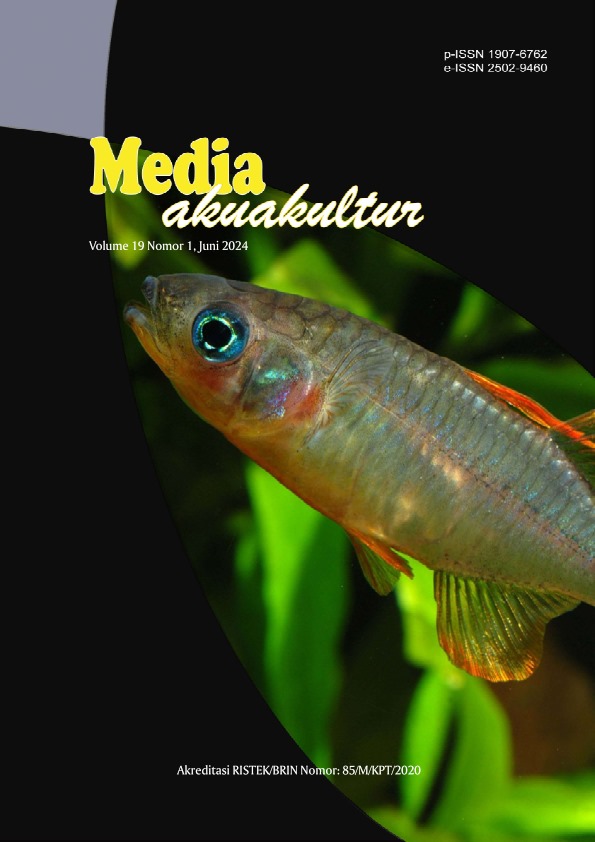
Downloads
Published
Issue
Section
License

Media Akuakultur is licensed under a Creative Commons Attribution-ShareAlike 4.0 International License.

