
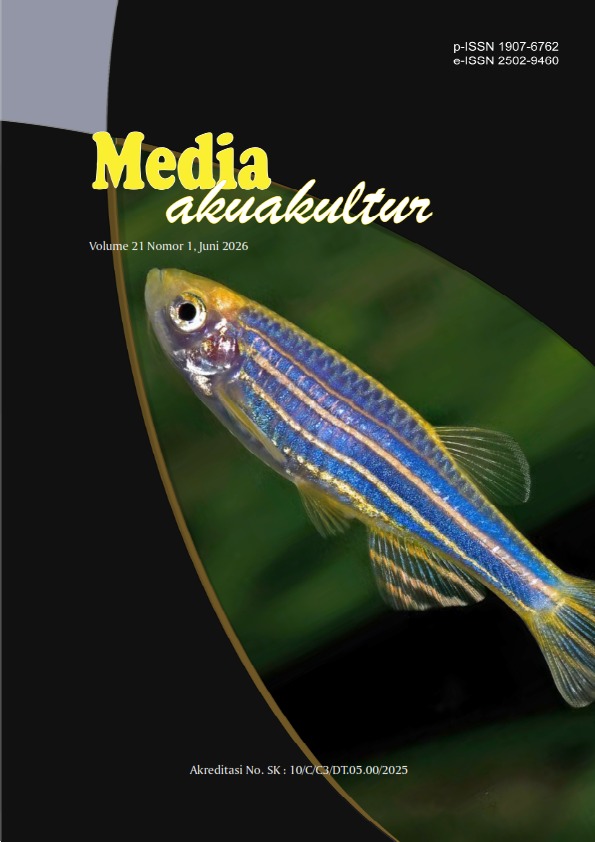
Reproductive performance of zebrafish (Danio rerio) after exposure of beneng taro leaf extract
DOI:
https://doi.org/10.15578/ma.21.1.2026.25-31Keywords:
Egg morphometry, fertilization rate, hatching rate, number of eggs, spawning, toxicityAbstract
Beneng taro leaves (Xanthosoma undipes) have potential benefits for fish, including reproductive performance; however, their application in aquaculture has not been widely studied. Therefore, investigating the effects of Beneng taro leaf extract on zebrafish (Danio rerio) reproduction is important as a basis for its potential application in aquaculture. This study aimed to analyze the reproductive performance of zebrafish after exposure to Beneng taro leaf extract solution. The reproductive performance parameters evaluated included egg number, egg morphometry, fertilization rate, and hatching rate. The study employed an experimental method using a Completely Randomized Design (CRD). A sublethal dose test was conducted at concentrations ranging from 250 to 450 ppm for 96 h. The reproductive performance test was conducted using a concentration of 350 ppm with exposure durations of 0, 24, 48, and 96 h. The results showed that exposure to a sublethal concentration of 350 ppm did not affect zebrafish reproductive performance. Statistical analysis indicated no significant differences among treatments. The average number of eggs produced in each treatment ranged from 43 ± 8 to 46 ± 5 eggs, while the fertilization rate ranged from 45 ± 2% to 50 ± 14% and the hatching rate ranged from 44 ± 4% to 47 ± 8%. Egg morphometry showed that egg diameter ranged from 1.15 ± 0.03 to 1.20 ± 0.02 mm, while yolk volume ranged from 0.084 ± 0.003 to 0.184 ± 0.020 mm³.
References
Adriana, M. D. (2025). Analysis of the chemical profile and functional properties of taro leaves (Xanthosoma undipes K. Koch) with different extraction methods [Thesis]. Faculty of Agriculture, Sultan Ageng Tirtayasa University. 101 pp
Al Ishaqi, A. M., & Sari, P. D. W. (2019). The spawning of koi (Cyprinus carpio) using semi-artificial method: The observation of fecundity, fertilization rate and hatching rate. Journal of Fisheries and Marine, 2089–3469
Alafia, A. A., Lai, K. S., Syahida, A., Mahmood, M., & Shaharuddin, N. A. (2019). Phytochemical evaluation, embryotoxicity, and teratogenic effects of Curcuma longa extract on zebrafish (Danio rerio) embryos. Evidence-Based Complementary and Alternative Medicine, 1–11. https://doi.org/10.1155/2019/3807207
Cabrita, E., Sarasquete, C., & Martínez-Páramo, S. (2022). Factors influencing fish egg and larval quality. Aquaculture, 548, 737634. https://doi.org/10.1016/j.aquaculture.2021.737634
Engdaw, F., & Geremew, A. (2024). Broodstock nutrition and reproductive performance in fish. Frontiers in Aquaculture, 3, 1281640. https://doi.org/10.3389/faquc.2024.1281640
Hasibuan, D., Komariyah, S., Putriningtias, A., & Batubara, P. A. P. (2023). The use of fermented taro leaf flour in gourami fish seed feed. Indonesian Aquaculture Journal
Heming, T. A., & Buddington, R. K. (1988). Yolk absorption in embryonic and larval fishes. In W. S. Hoar & D. J. Randall (Eds.), Fish physiology: Vol. XI, Part A. The physiology of developing fish, eggs and larvae (pp. 407–446). Academic Press, New York
Herjayanto, M., Carman, O., & Soelistyowati, D. T. (2016). Spawning behavior, reproductive potential of female fish, and optimization of rainbow fish spawning techniques Iriatherina werneri Meinken, 1974. Indonesian Journal of Ichthyology, 16(2), 171–183
Hermita, N., Fatmawaty, A. A., & Hastuti, D. (2019). Phytochemical content test of wild taro leaves (Xanthosoma undipes K. Koch) around the Coral Mountain area, Banten. Journal of Agros Agriculture, 231–235
Hermita, N., Ningsih, E. P., & Fatmawaty, A. A. (2017). Analysis of proximate and oxalic acid on wild taro leaf fronds. Journal of Agroscience and Technology, 2(2)
Indrayani, N., Yuliana, R., & Setyawan, D. (2020). Acute toxicity assessment of plant extracts on freshwater fish. International Journal of Fisheries Science, 5(1), 12–20. https://doi.org/10.1111/ijfs.2020.50112
Khotimah, H., & Ali, M. M. (2020). Zebrafish (Danio rerio) as a model animal in biomedical research and how to maintain it. Sanus Med J., 1(1), 1–10
Kimmel, C. B., Ballard, W. W., Kimmel, S. R., Ullmann, B., & Schilling, T. F. (1995). Stages of embryonic development of the zebrafish. Developmental Dynamics, 203(3), 253–310. https://doi.org/10.1002/aja.1002030302
Larasati, S., Basuki, F., & Yuniarti, T. (2017). Effect of pineapple juice with different concentrations on the degree of fertilization and hatching of catfish eggs (Pangasius pangasius). Journal of Aquaculture Management and Technology, 6(4), 218–225
Lawrence, C. (2007). The husbandry of zebrafish (Danio rerio): A review. Aquaculture, 269(1–4), 1–20. https://doi.org/10.1016/j.aquaculture.2007.04.077
Lawrence, C. (2016). Advances in zebrafish husbandry and management. ILAR Journal, 57(2), 1–13
Lei, P., Zhang, W., Ma, J., Xia, Y., Yu, H., Du, J., Fang, Y., Wang, L., Zhang, K., Jin, L., Sun, D., & Zhong, J. (2023). Advances in the utilization of zebrafish for assessing and understanding the mechanisms of nano-/microparticles toxicity in water. Toxics, 11(4), 380. https://doi.org/10.3390/toxics11040380
Makkar, H. P. S., Francis, G., & Becker, K. (2021). Bioactivity of phytochemicals in aquaculture. Aquaculture Research, 52(4), 1503–1515. https://doi.org/10.1111/are.15021
Miratsi, L., Kurniawan, W. B., & Indriawati, A. (2024). Application of electrocoagulation method in improving the quality of FeCl3 solution.6H2O. Indonesian Journal of Physics Research, 5(1), 1928
Misaghi, A., Shaluei, F., Mohammadi, Y., & Mirrasooli, E. (2020). Influence of water temperature on embryonic development of zebrafish (Danio rerio). Journal of Applied Aquaculture, 32(3), 265–276
Muchlisin, Z. A., Arisa, A. A., Muhammadar, A. A., Fadli, N., Arisa, I. I., & Siti Azizah, M. N. (2016). Growth performance and feed utilization of keureling (Tor tambra) fingerlings fed a formulated diet with different doses of vitamin E (alpha-tocopherol). Archives of Polish Fisheries, 23, 47–52
Nguyen, T. H., Nguyen, P. D., Quetin-Leclercq, J., Muller, M., Huong, D. T. L., Pham, H. T., & Kestemont, P. (2021). Developmental toxicity of plant extracts on zebrafish embryos. Journal of Ethnopharmacology, 267, 113538
Nurfiana, I. N. (2020). Effect of egg stimulant on feed on gonad maturity level and zebra egg diameter (Danio rerio) [Thesis]. Brawijaya University
Orozco, A. I., Vargas, M., & Serrano, L. (2020). Oxidative stress induced by plant secondary metabolites in aquatic organisms. Ecotoxicology, 29, 1200–1212. https://doi.org/10.1007/s10646-020-02228-1
Parichy, D. M. (2015). Advancing biology through zebrafish research. Developmental Biology, 2(3), 1–10
Pratiwi, R. A. (2021). The effect of water quality variations on the spawning success of zebrafish (Danio rerio) [Thesis]. University of Lampung
Ridho, R. (2021). Analysis of the toxicity of papaya leaf extract to zebrafish. Indonesian Journal of Aquaculture, 10(2), 88–96. https://doi.org/10.1234/jaki.v10i2.88
Rudiyanti, S., & Ekasari, D. (2009). Growth and survival rate of carp (Cyprinus carpio Linn) at various concentrations of pesticide Regent 0.3 G. Journal of Fisheries Science, 5(1), 39–47
Rumahorbo, P. L. (2024). Toxicity test for histological analysis of the gonads of betok fish (Anabas testudineus) exposed to lead heavy metals (Pb)
Siregar, R. A., Widodo, M. S., & Pratiwi, D. Y. (2021). Effect of plant extract exposure on reproductive performance of zebrafish (Danio rerio). Indonesian Journal of Aquatic Biology, 6(1), 12–18
Spence, R., Gerlach, G., Lawrence, C., & Smith, C. (2008). The behaviour and ecology of the zebrafish, Danio rerio. Biological Reviews, 83(1), 13–34
Sudradjat, S. (2019). Test the toxicity of the drug with zebrafish larvae. J.K. Medicine, 25(2), 88–93
Susilawati, P. N., Yursak, Z., Kurniawati, S., & Saryoko, A. (2021). Technical instructions for cultivation and processing of taro varieties of benek. Banten Agricultural Technology Assessment Center (BPTP)
U.S. Environmental Protection Agency. (2012). Ecological effects test guidelines, OCSPP 850.1075: Acute toxicity test for freshwater fish. https://www.epa.gov/test-guidelines-pesticides-and-toxic-substances
Utami, C. S. (2023). Effect of growth and reproductive performance of female zebrafish (Danio rerio) exposed to oil palm liquid waste at subchronic concentrations [Doctoral dissertation]. Ar-Raniry State Islamic University
Utomo, N. B. P. (2009). Improving the reproductive quality of ornamental fish through the provision of a combination of essential fatty acids and vitamin E in feed for zebra test fish (Danio rerio) [Dissertation]. Graduate School, Bogor Agricultural University, Bogor
Westerfield, M. (2000). The zebrafish book: A guide for the laboratory use of zebrafish (Danio rerio). University of Oregon Press
Zainol Abidin, I. Z. (2020). The effects of Piper sarmentosum aqueous extracts on zebrafish embryo development. Scientific Reports, 10, 14238. https://doi.org/10.1038/s41598-020-70962-7
Zhang, Y., Liu, X., & Wang, L. (2022). Role of antioxidants in fish reproduction and embryo development. Aquaculture Reports, 23, 101034. https://doi.org/10.1016/j.aqrep.2022.101034
Downloads
Published
Issue
Section
License

Media Akuakultur is licensed under a Creative Commons Attribution-ShareAlike 4.0 International License.

